
 0161 4433 227


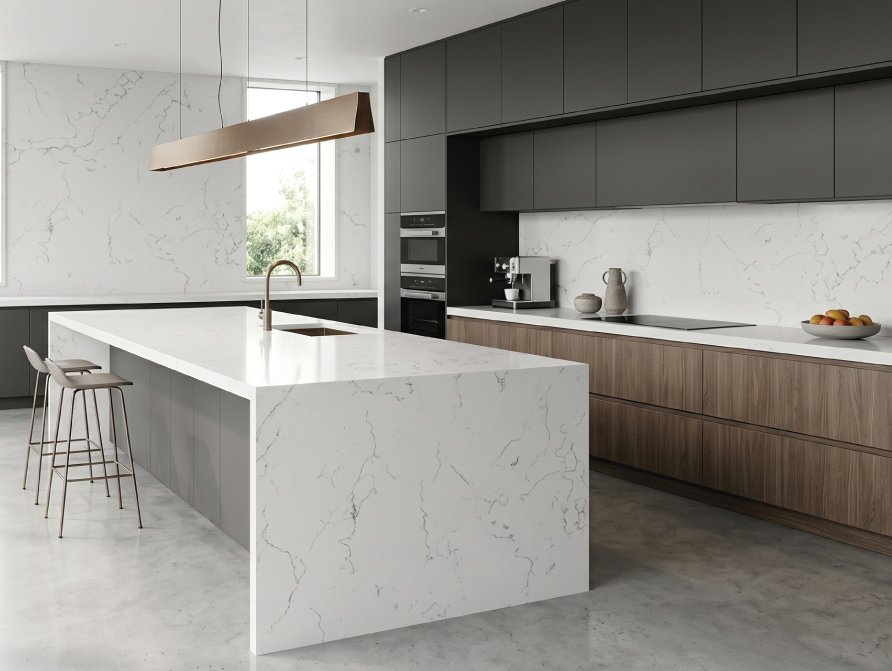
Quartz, Marble & Granite: which to choose for your kitchen worktops?
Marble, granite or quartz – how to choose?!
Choosing a new kitchen worktop is tough as you want to make sure you’ve picked something durable, practical, gorgeous, timelessly stylish, good value for money and that you’ll love for years. Even if you’ve narrowed the choice down to a stone worktop, such as marble, granite, limestone or quartz, then there are still dozens of options available. Below, we explain some of the differences between different types of worktop but if you have any more questions, just give us a call – our team are on hand to help you choose the right surface for your new kitchen.
Stone kitchen worktops vs other surfaces
One reason it’s hard to choose between, marble, quartz and granite kitchen worktops is that stone has a number of significant advantages over most other worktop materials. For example, all stones – even ‘soft’ stones like marble – are:
available in multiple colours and textures
cut to fit your exact kitchen
available in a range of finishes, polishes and edge details
hard to chip or scratch
heat resistant – even if you put a hot pan or cup of tea down
fire and flame resistant
unaffected by cold
food safe
won’t fade in sunlight
easy to clean
heavier than wood, lino or tiles
need to be cut, shaped and polished using special tools
and have little or no grouting to discolour or rot away
Stone also acts as a heat sink, which is why professional pastry chefs and chocolate makers use marble or granite kitchen worktops to make their products.
Natural vs engineered stone
Thanks to modern technologies, it is now possible to make stone in a factory, using bonding agents or high-tech processes to bind stone particles together into new forms. They are often made primarily of natural quartz. These innovative products are known as ‘engineered’ or ‘processed’ stones, to differentiate them from ‘natural’ stones like marble, granite and limestone which are formed in the earth’s surface and mined from quarries.
Engineered stones have been carefully designed to fulfil the function they’re intended for. As a result, they’re an ideal choice for kitchen and bathroom worktops. As well as the general advantages listed above, engineered stone is:
available in hundreds of colours, including primary colours and jewel tones
available in dozens of textures, from plain to complex
easy to match
made in a range of thicknesses, suitable for different uses, such as wall cladding, worktops and flooring
naturally non-porous, which means nothing is absorbed by it – not smells, bacteria, liquid or anything
nearly impossible to stain
waterproof
typically 90-95% quartz
By contrast, natural stones are formed in geological processes, so their colours and textures are created by chance. This means that natural stones are:
available in the colours and textures nature provides
each slab is completely unique, so may be hard to match
can be porous so needs to be sealed during manufacture or installation
hard to stain, particularly after sealing
Granite is one of the toughest materials in the world, which is one reason granite kitchen worktops are so sought after. This beautiful stone is naturally non-porous, hard to stain, scratch or chip and easy to care for. By contrast, marble is a more delicate stone as, although it’s tough as rock, it’s porous and reacts with acids and alkalis. This means that unless it is sealed it can stain or be damaged by foods and liquids such as red wine, lemon juice and vinegar. Fortunately, sealing is very effective and a standard part of our process.
Join the conversation
Comments
No comments yet
Be the first to share your thoughts on this article.